Ball Run 2048: merge number
- 4.1
- Rating
- 100.00M
- Installs
- Free
- Price

 Analysis by App-foxy
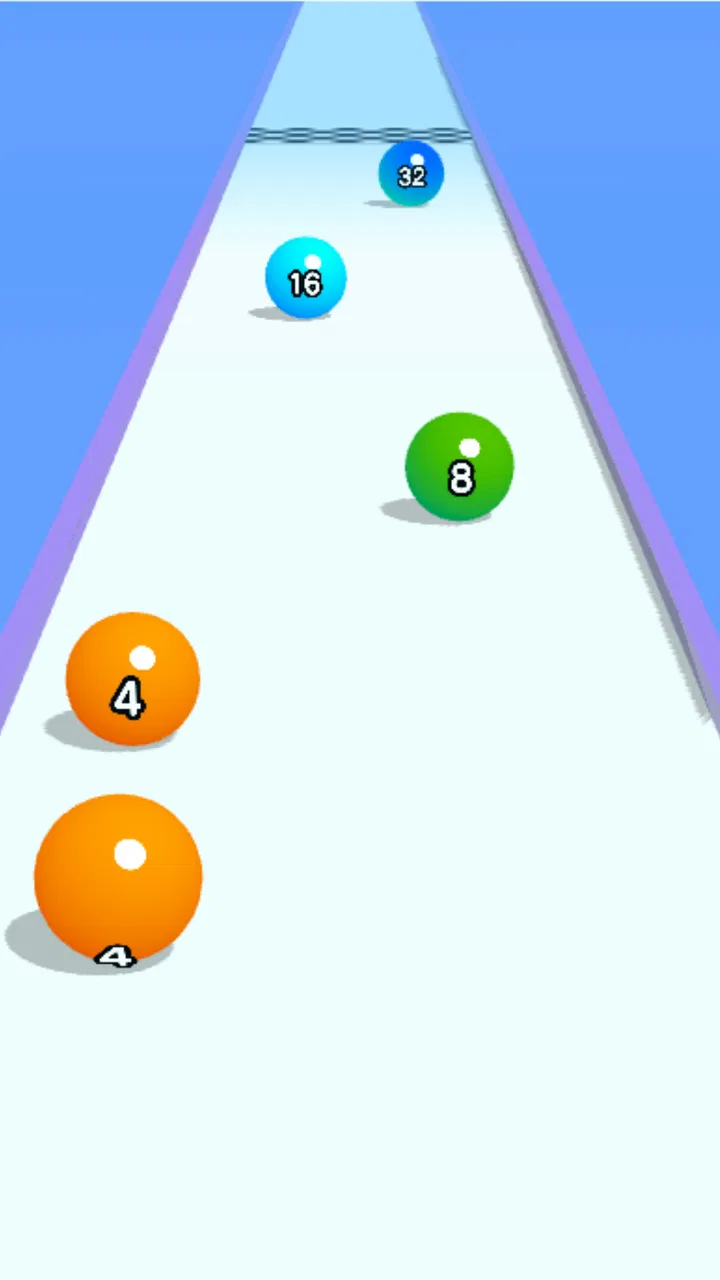
I picked up Ball Run 2048: merge number expecting a quick casual distraction, and that is exactly where it works best. You guide a rolling ball, collect matching numbers, merge them, and try to finish with a larger value. The idea is easy to understand within seconds, but the run itself asks for more attention than the simple presentation suggests. A small steering mistake can send the ball toward the wrong pickup, while a good route can turn a modest start into a satisfying chain of upgrades.
It is a free casual game from KAYAC Inc., aimed at players who like short sessions rather than long campaigns or complicated controls. Its Teen content rating is worth noticing before installing, especially if you are choosing games for a younger player. The game has been available since March 11, 2021, and version 0.8.7 is the version I considered while writing this review. It supports devices running Android 6.0 or later.
What makes it appealing is the combination of movement and number merging. This is not a traditional stationary 2048 board where I can pause over every move. The numbers are attached to a forward-moving route, so I have to think about positioning and timing at the same time. That gives the familiar number concept a more physical, immediate feel.
You May Also Like

 Blood Strike: 2.5 Anniversary
Blood Strike’s Loadouts Turn Every Drop Into a Tactical Gamble
A close look at Blood Strike’s custom loadouts: how fast access to signature weapons reshapes its battle royale rhythm, rewards preparation, and narrows the gap between fights.

 Pandora - Music & Podcasts
Pandora’s Music Is Easy to Start, but Harder to Recover
Pandora’s strength is its low-effort path from a seed to a station. Its weak spot is how much confidence it asks you to place in connection, setup, and quiet recovery.

 8 Ball Pool
 Is Built on Rivalries, Rematches, and Routine
A close look at the rivalries, rematches, shared routines, and unanswered safety questions that turn a quick pool match into a persistent mobile community.

 Samsung Music
’s Quiet Strength Is Playing What You Already Own
Its reach comes less from spectacle than from dependable access to a personal library. That simplicity is both the app’s strongest retention engine and its ceiling.

 AccuWeather: Weather Radar
AccuWeather Review: A Quick, Clear Forecast for Everyday Decisions
For everyday plans, the best forecast is the one you can understand quickly. AccuWeather makes rain timing, radar, and local conditions easy to act on, with a few trade-offs.

 Hill Climb Racing
Why Hill Climb Racing Still Turns Crashes Into One More Run
A tiny car, a bumpy hill and one more upgrade: Hill Climb Racing keeps resurfacing because its simple chaos makes every near-miss feel personal.
More From Our News Desk
View All News


How the run-and-merge idea feels in practice
I find the run-and-merge idea most useful when I treat each attempt as a quick lesson in positioning, not just a race toward a bigger number. Watching where a small steering correction leaves me for the next pickup can make even a short session feel purposeful. That practical rhythm is a good starting point for weighing what the free game offers and where its limits may matter.
Simple controls with a surprisingly active decision loop
The basic interaction is deliberately approachable. I steer the ball left or right, line it up with useful numbered balls, and let the merging process improve the value I am carrying. There is no lengthy tutorial to study, and the central objective is clear enough that someone unfamiliar with number games can understand it almost immediately.
The challenge comes from making decisions while the course continues to unfold. I am not simply asking which number is mathematically best. I am also judging whether I can reach it cleanly, whether taking it will pull me away from a better option, and whether the route ahead is worth the risk. That makes each run feel more like a sequence of small corrections than a single puzzle solution.
One useful habit is to stop chasing every attractive number. Early in a run, collecting something that keeps the ball aligned can be better than making a sharp move for a slightly better pickup. A clean line often preserves more opportunities later, while an ambitious sideways move can leave me entering the next section badly positioned. This is one of the first trade-offs that is easy to miss when starting.
I also found it helpful to look beyond the next ball. The immediate target is tempting, but the next section of the path can matter more. If I move toward a number that leaves me on the edge, I may have fewer options afterward. When I stay near the middle where possible, I have more time to react. That is a small tactical adjustment, but it makes failed runs feel less random.
Why the 2048 theme works better here than expected
The number-merging theme gives the game a clear sense of progress. Even when a run ends quickly, I understand what I was trying to improve. The numbers are not just decoration; they create a reason to choose one lane over another and make successful combinations feel meaningful.
At the same time, this is not a replacement for the classic 2048 puzzle. In the original style of game, the main pleasure comes from planning a board several moves ahead. Here, the pressure comes from steering through a moving course. Players who enjoy careful, turn-based calculation may find the action less precise than they want. I prefer it when I want a more relaxed, hands-on version of the same broad idea.
The best sessions happen when I treat the game as a rhythm exercise rather than a pure mathematics test. I watch the route, make moderate corrections, and avoid overreacting to every new pickup. Large, sudden movements are usually harder to recover from than small ones. That approach is particularly useful when playing with one hand during a short break.
What a normal everyday session looks like
A realistic use case is a five-minute wait before an appointment or while commuting on public transport. I can start a run without remembering a complicated story, team setup, or inventory. If the session ends, there is no need to reconstruct a large plan before trying again. The game is well suited to that kind of fragmented free time.
I would not choose it for a quiet evening when I want a deep puzzle to solve. The forward motion keeps the experience active, but it also means I have less control over the pace of thinking. A player who wants to stop, compare several possible moves, and build a long strategy will probably be happier with a conventional number puzzle.
Another good use is as a low-commitment change of pace after playing a demanding action game. The controls are lighter, and the objective is much narrower. It still gives me something to focus on, but it does not ask me to learn a large map or manage multiple systems.
Three practical techniques that improve consistency
First, I recommend prioritizing stable positioning over maximum collection during the opening part of a run. The temptation is to grab anything that appears valuable, but a ball that keeps the route manageable can be more useful than one that forces a risky correction. This is especially important for new players who are still learning how quickly the ball responds.
Second, I try to make a correction before the target is directly beside me rather than waiting until the last moment. Early movement leaves room to adjust if the approach is not quite right. Late movement tends to become an all-or-nothing swipe, and that is where many avoidable misses happen.
Third, I use failed attempts as route practice instead of judging them only by the final number. If I repeatedly lose control in the same kind of section, I focus on entering it from a better position on the next attempt. This turns repetition into something useful. The game becomes less about hoping for a favorable path and more about improving how I approach familiar situations.
Value, limitations, and who should install it
When deciding whether to install it, I would balance its easy entry and brief sessions against the fact that the core activity stays focused on the same kind of run. I also think it helps to separate the game’s free price from assumptions about purchases or competitive advantages: I can judge the entry cost, but not details that are unavailable. With that in mind, the next section considers who is likely to enjoy it and who may prefer another casual game.
What the free price means for the decision
The game is free to download and play, so the financial barrier is low. That matters because its main strength is short-session entertainment rather than a large, long-form experience. I can try the core idea without committing money to a purchase, which makes experimentation easy.
Free access does not automatically make every minute valuable, of course. The real question is whether the merge-and-run loop stays enjoyable after the novelty fades. For me, it works in bursts. I can return for a few attempts when I want something simple, but I would not treat it as my only casual game. Its value comes from convenience and immediacy, not from offering the depth of a premium puzzle or a substantial adventure.
Since the price is free, I judge it by how quickly it gets me into a playable session and whether the repeated runs feel fair enough to continue. It succeeds on the first point. The second depends heavily on personal taste: players who enjoy retrying a compact challenge may find plenty to like, while players who need constant new content may tire of the central loop sooner.
The main trade-offs before installing
The strongest trade-off is between accessibility and depth. The controls and objective are easy to pick up, but that simplicity also limits how much there is to master. I can improve my steering and route choices, yet the game does not offer the same broad strategic space as a full puzzle system.
Another trade-off is between momentum and control. Movement makes the familiar number concept feel lively, but it removes the calm, deliberate pace that many people associate with 2048. If you enjoy reacting quickly and correcting your position, that is a strength. If you dislike pressure in puzzle games, it may feel frustrating rather than relaxing.
The Teen rating also means I would not install it automatically on a child’s device without checking whether it suits that player. The rating is a practical part of the decision, even though the game itself presents a colorful and approachable concept. Parents choosing a casual game should consider the age guidance instead of relying only on the simple controls.
Device compatibility is reasonably broad because the game runs on Android 6.0 and newer, but users on very old hardware should still keep their general phone performance in mind. I would make sure the operating system meets that requirement before spending time troubleshooting an installation.
How it compares with familiar casual alternatives
Compared with a standard 2048 app, this game is more immediate and less contemplative. I am physically guiding the object toward opportunities instead of sliding rows on a fixed board. That makes it a better fit for someone who wants the theme of merging numbers but prefers movement and quick reactions.
Compared with endless runners, it has a clearer numerical objective. In a typical runner, distance and obstacle avoidance may be the central focus. Here, collecting and merging numbers gives each directional choice an additional purpose. The result is still approachable, but it feels more goal-driven than simply surviving as long as possible.
Compared with match-three games, the interaction is less about arranging a grid and more about maintaining a route. There is no need to scan a board for several possible combinations before acting. That makes Ball Run 2048 easier to start, but it also means players who love layered combo planning may find it comparatively thin.
For me, the best alternative depends on the mood. I choose this game when I want a quick active diversion. I choose a traditional number puzzle when I want to think slowly. I choose a richer runner when I want more variety in obstacles, progression, or long-term goals. It does not replace those games; it occupies a useful middle ground.
Who will get the most from it
This is a good match for casual players who enjoy short attempts, visible numerical progress, and controls that can be learned quickly. It also suits people who like replaying the same basic challenge to improve their timing. If you enjoy noticing that a small change in approach produces a better result, the game gives you enough room to practice.
It is particularly convenient for players who do not want to invest in a complicated game before knowing whether they will enjoy it. The free price makes trying it straightforward, and the broad Android operating-system requirement makes it accessible to many users. I would still check the Teen rating when choosing it for someone else.
I would skip it if you want a story, deep character progression, a large collection of modes, or a puzzle that can be paused at every decision. I would also skip it if repeated short runs feel more irritating than satisfying. The game asks you to accept its compact loop and find enjoyment in gradual improvement.
My recommendation after weighing the experience
After spending time with it, I see Ball Run 2048 as a focused casual game rather than a complete all-purpose entertainment package. Its best idea is the way it combines steering with number merging: I have to think about what I want to collect and how to reach it without losing control. That gives a familiar concept enough movement to feel distinct.
The limitations are just as clear. The experience can become repetitive for players who need constant variety, and the active route makes it less suitable for anyone seeking a slow, purely strategic 2048-style puzzle. The Teen content rating is another detail to consider before recommending it to a younger player.
Its popularity is substantial, with an average rating of 4.2 from around 253 thousand ratings and more than 100 million installs. Those figures suggest that the short, approachable format has found a large audience, but they do not remove the need to consider your own preferences. I would not install it because it is popular alone; I would install it because the particular mix of running, steering, and merging sounds like the kind of brief challenge I want.
My verdict is positive, with a clear condition: try it if you want a free, easy-to-start game for short bursts and enjoy improving through repetition. Skip it if you are looking for a deep number puzzle or a long-term game with many different systems. For the right player, the most valuable feature is not the final number but the small decisions that help you reach it. That is what keeps the runs engaging, even when I only have a few minutes to play.
FAQs for Ball Run 2048: merge number
01What is the main objective of Ball Run 2048: Merge Number?
The primary objective of Ball Run 2048 is to navigate a ball through various obstacles while merging numbers to reach the ultimate goal of 2048. Players must skillfully control the ball to merge with other numbers, strategically planning each move to avoid pitfalls and maximize their score.
02Is Ball Run 2048 suitable for all age groups?
Yes, Ball Run 2048 is designed to be family-friendly and suitable for all age groups. Its simple mechanics and colorful graphics make it appealing to both children and adults. However, younger players may require some guidance initially to understand the merging mechanics.
03Are there in-app purchases in Ball Run 2048?
Ball Run 2048 does offer in-app purchases that can enhance the gaming experience. These purchases typically include items like additional lives, special boosts, or cosmetic upgrades. While the game is free to play, these optional purchases can help support the developers and unlock extra features.
04Does Ball Run 2048 require an internet connection to play?
No, Ball Run 2048 can be played offline, making it an excellent choice for users who want to enjoy the game without worrying about connectivity issues. However, an internet connection may be required for initial downloads, updates, or accessing certain online features like leaderboards.
05How challenging is Ball Run 2048 for new players?
Ball Run 2048 offers a balanced level of challenge that gradually increases as players advance through the game. New players may find the initial levels easy to grasp, while later stages require more strategic planning and quicker reflexes. The game’s learning curve is designed to be engaging yet rewarding.
Pros
- Engaging and addictive gameplay.
- Smooth and responsive controls.
- Visually appealing graphics.
- Frequent updates with new levels.
- Easy to learn for all ages.
Cons
- Contains in-app purchases.
- Can become repetitive over time.
- Occasional ads disrupt gameplay.
- Requires a stable internet connection.
- Limited offline features.

Ball Run 2048: merge number
Gallery